Haffner, Christian, et al. “Plasmonic organic hybrid modulators—scaling highest speed photonics to the microscale.” Proceedings of the IEEE 104.12 (2016): 2362-2379.

Transparent Optical-THz Link at 240/192 Gbit/s over 5/115 m Enabled by Plasmonics
Transparent Optical-THz-Optical Link at
240/192 Gbit/s over 5/115 m Enabled
by Plasmonics
Yannik Horst, Tobias Blatter, Laurenz Kulmer, Bertold Ian Bitachon, Benedikt Baeuerle,
Marcel Destraz, Wolfgang Heni, Stefan Koepfli, Patrick Habegger, Marco Eppenberger, Eva De Leo,
Claudia Hoessbacher, Delwin L. Elder, Scott R. Hammond, Lewis E. Johnson,
Larry R. Dalton, Senior Member, IEEE, Yuriy Fedoryshyn, Yannick Salamin,
Maurizio Burla, Senior Member, IEEE, and Juerg Leuthold, Fellow, IEEE25, 1762-1768 (2017)
Abstract
A transparent Optical-subTHz-Optical link providing record-high single line rates of 240 Gbit/s and 192 Gbit/s on a single optical carrier over distances from 5 to 115 m is demonstrated. Besides a direct mapping of the optical to a 230 GHz subTHz-carrier frequency by means of a uni-traveling carrier (UTC) photodiode, we demonstrate direct conversion of data from the subTHz domain back to the optical domain by a plasmonic modulator. It is shown that the subTHz-to-optical upconversion can even be performed at good quality without any electrical amplifiers. Finally, at the receiver, the local oscillator is employed to directly map the optical signal back to the electrical baseband within a coherent receiver.
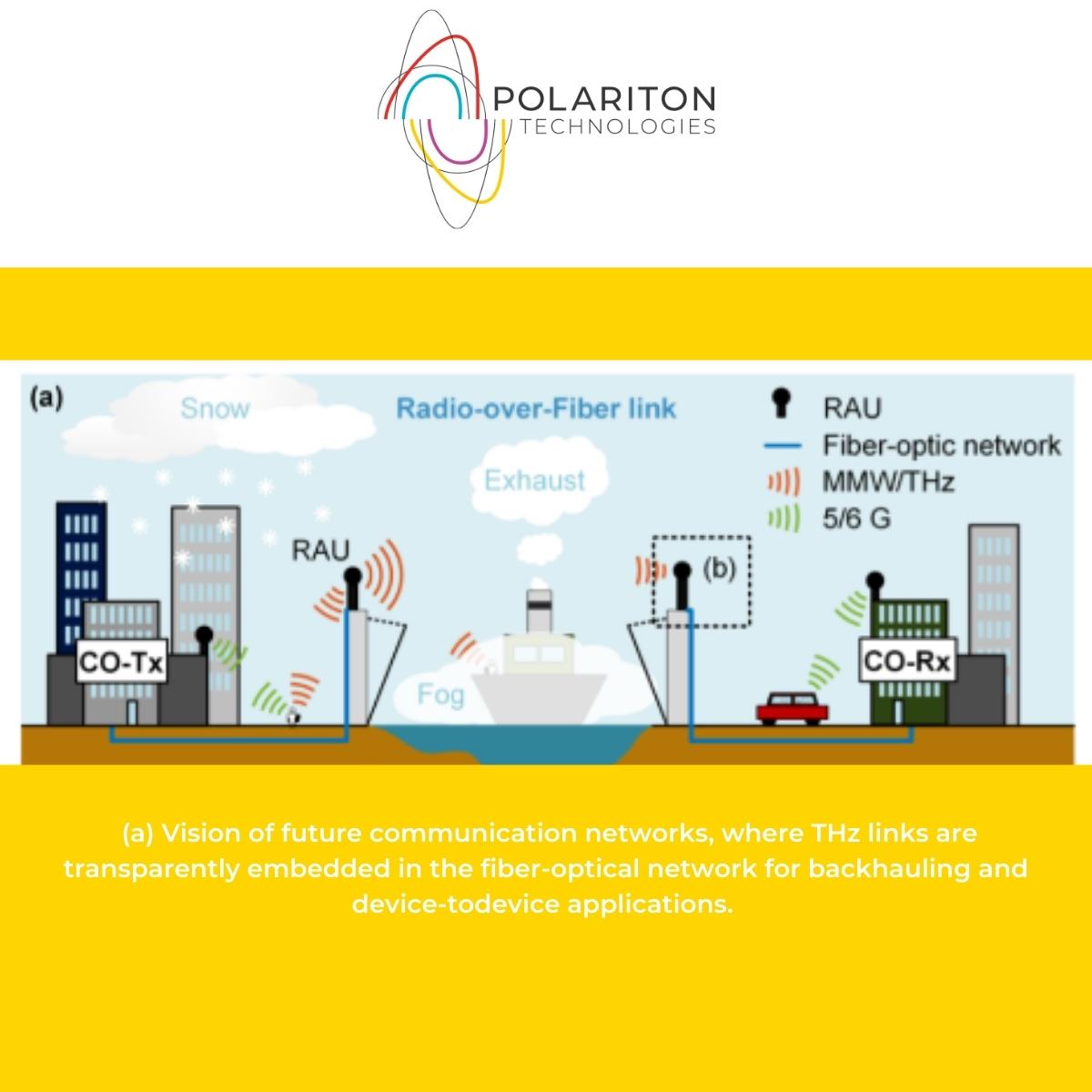
Fig. 1. (a) Vision of future communication networks, where THz links are transparently embedded in the fiber-optical network for backhauling and device-todevice applications.
Transparent Optical-THz-Optical Link at 240/192 Gbit/s over 5/115 m Enabled by Plasmonics

Design and synthesis of chromophores with enhanced electro-optic activities in both bulk and plasmonic–organic hybrid devices
Design and synthesis of chromophores with enhanced electro-optic activities in both bulk and plasmonic–organic hybrid devices
Xu, Huajun, et al. “Design and synthesis of chromophores with enhanced electro-optic activities in both bulk and plasmonic–organic hybrid devices.” Materials Horizons (2022).
Abstract:
This study demonstrates enhancement of in-device electro-optic activity via a series of theory-inspired organic electro-optic (OEO) chromophores based on strong (diarylamino)phenyl electron donating moieties. These chromophores are tuned to minimize trade-offs between molecular hyperpolarizability and optical loss. Hyper-Rayleigh scattering (HRS) measurements demonstrate that these chromophores, herein described as BAH, show >2-fold improvement in β versus standard chromophores such as JRD1, and approach that of the recent BTP and BAY chromophore families. Electric field poled bulk devices of neat and binary BAH chromophores exhibited significantly enhanced EO coefficients (r33) and poling efficiencies (r33/Ep) compared with state-of-the-art chromophores such as JRD1. The neat BAH13 devices with charge blocking layers produced very large poling efficiencies of 11.6 ± 0.7 nm2 V−2 and maximum r33 value of 1100 ± 100 pm V−1 at 1310 nm on hafnium dioxide (HfO2).
These results were comparable to that of our recently reported BAY1 but with much lower loss (extinction coefficient, k), and greatly exceeding that of other previously reported OEO compounds. 3 : 1 BAH-FD : BAH13 blends showed a poling efficiency of 6.7 ± 0.3 nm2 V−2 and an even greater reduction in k. 1 : 1 BAH-BB : BAH13 showed a higher poling efficiency of 8.4 ± 0.3 nm2 V−2, which is approximately a 2.5-fold enhancement in poling efficiency vs. JRD1. Neat BAH13 was evaluated in plasmonic–organic hybrid (POH) Mach–Zehnder modulators with a phase shifter length of 10 μm and slot widths of 80 and 105 nm. In-device BAH13 achieved a maximum r33 of 208 pm V−1 at 1550 nm, which is ∼1.7 times higher than JRD1 under equivalent conditions.

Plasmonic Modulator IM/DD Transmitter Operating at 222 GBaud for Intra-Datacenter Applications
Plasmonic Modulator IM/DD Transmitter Operating at 222 GBaud for Intra-Datacenter Applications
Heni, Wolfgang, Journal of Lightwave Technology 38.9 (2020): 2734-2739.
We present a plasmonic modulator IM/DD transmitter operating at 222 GBaud for ultra-fast intra-datacenter applications. This high-speed transmitter enables >200 Gb/s OOK for short-reach transmission and >177 Gb/s over 120 m of standard fiber, overcoming chromatic dispersion limitations.
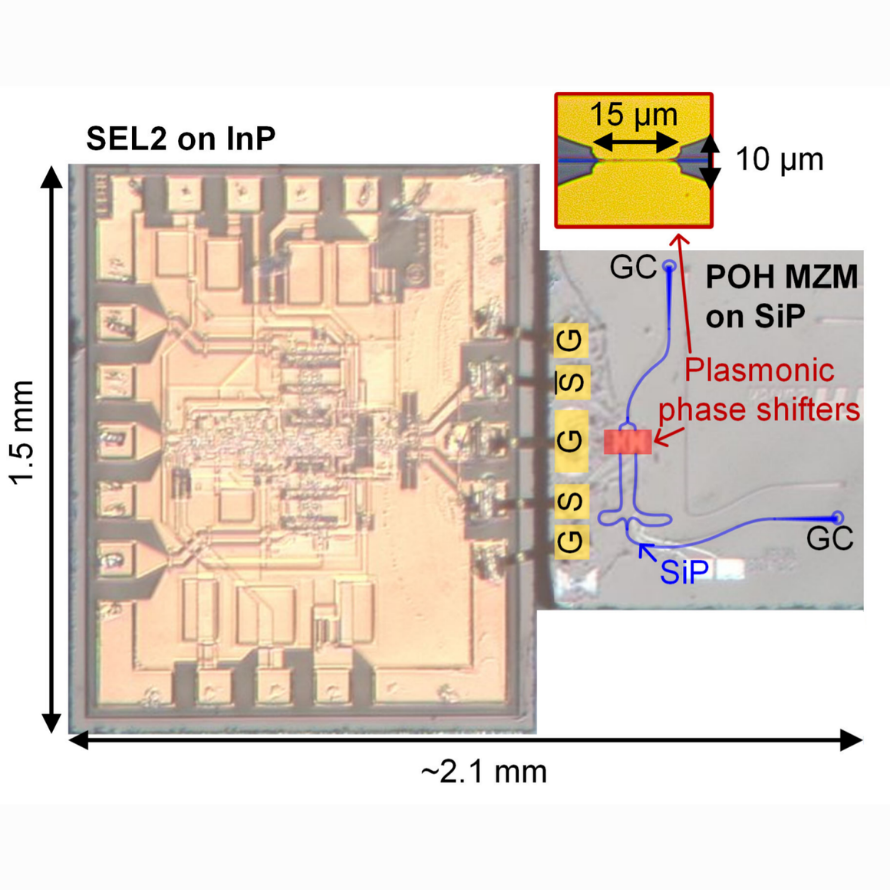
Fig. 1. 222 GBd transmitter assembly consisting of an InP DHBT 2:1- digital selector (SEL) and plasmonic organic hybrid (POH) Mach–Zehnder modulator (MZM) on silicon photonics. The RF electrodes of the modulator are ribbon-bonded to the output stage of the SEL. The assembly requires less than 2.1 × 1.5-mm².

100 GBd IM/DD transmission over 14 km SMF in the C-band enabled by a plasmonic SSB MZM
100 GBd IM/DD transmission over 14 km SMF in the C-band enabled by a plasmonic SSB MZM
Benedikt Baeuerle, Claudia Hoessbacher, Wolfgang Heni, Yuriy Fedoryshyn, Ueli Koch, Arne Josten, Delwin L. Elder, Larry R. Dalton, and Juerg Leuthold, “100 GBd IM/DD transmission over 14 km SMF in the C-band enabled by a plasmonic SSB MZM,” Opt. Express 28, 8601-8608 (2020)
Abstract:
100 Gb/s NRZ-OOK transmission over 14 km standard single mode fiber in the C-band is demonstrated with a simple intensity modulation and direct detection scheme. The transmission concept utilizes single sideband modulation and comprises a single differential digital-to-analog converter with adjustable phase offset, a new dual electrode plasmonic Mach-Zehnder modulator, a laser at 1537.5 nm, standard single mode fibers, a photodiode, an analog-to-digital converter, and linear offline digital signal processing. The presented SSB concept requires no DSP and complex signaling at the transmitter. The demonstrated SSB transmitter increased the possible transmission distance by a factor of 4.6 compared to a DSB transmitter. We also investigated the equalization requirements. A T/2-spaced feedforward equalizer requires 27 taps to achieve transmission over 10 km with a BER below the HD-FEC limit. In comparison to a DSB transmitter, the SSB transmitter reduced the receiver DSP complexity by a factor of 13.7.
© 2020 Optical Society of America under the terms of the OSA Open Access Publishing Agreement
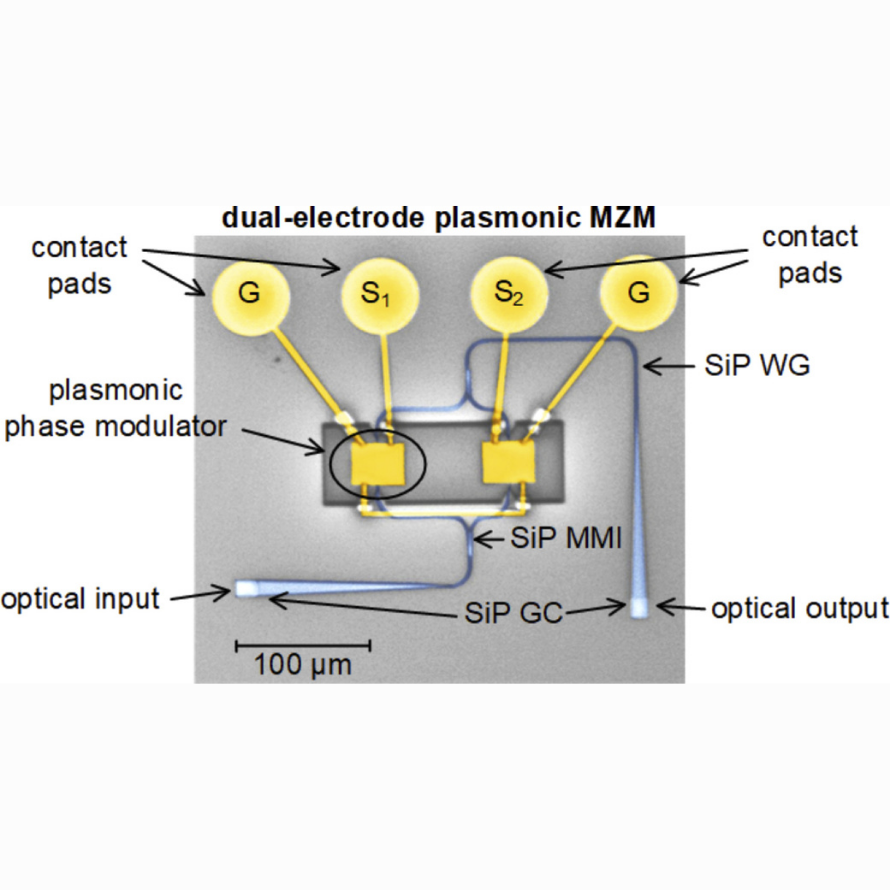
Fig. 1. Colorized microscope picture of the dual-electrode plasmonic Mach-Zehnder modulator (P-MZM). It comprises MZ interferometer with silicon photonic (SiP) waveguides (WGs) and SiP multimode interference (MMI) couplers and two plasmonic phase modulators. Light is coupled to and from the chip via SiP grating couplers (GC). The electrical signal is contacted via two ground (G) signal (S) contact pads.
Transparent Optical-THz-Optical Link Transmission over 5/115 m at 240/190 Gbit/s Enabled by Plasmonics
Transparent Optical-THz-Optical Link Transmission over 5/115 m at 240/190 Gbit/s Enabled by Plasmonics
Horst, Yannik, et al. “Transparent optical-THz-optical Link transmission over 5/115 m at 240/190 Gbit/s enabled by plasmonics.” 2021 Optical Fiber Communications Conference and Exhibition (OFC). IEEE, 2021.
Abstract:
The first transparent Optical-THz-Optical link providing record-high line-rates up to 240 and 190 Gbit/s over distances from 5 to 115m is demonstrated. The link is based on direct data-conversion from optical to sub-THz and vice-versa.
Interview with Yannik Horst:

Low-Power Data Center Transponders Enabled by Micrometer-scale Plasmonic Modulators
Low-Power Data Center Transponders Enabled by Micrometer-scale Plasmonic Modulators
Baeuerle, Benedikt, et al. “Low-Power data center transponders enabled by Micrometer-scale plasmonic modulators.” Optical Fiber Communication Conference. Optical Society of America, 2020.
Abstract:
Plasmonic modulators allow for high-speed data modulation beyond 200 GBd at the micrometer-scale and low driving voltages below 700 mV. The compact footprint enables dense integration and makes plasmonic modulators a promising solution for next-generation optical interconnects.

All-plasmonic Mach–Zehnder modulator enabling optical high-speed communication at the microscale
2015
All-plasmonic Mach Zehnder modulator enabling optical high-speed communication at the microscale
C. Haffner, et al, All-plasmonic Mach–Zehnder modulator enabling optical high-speed communication at the microscale, Nature Photonics, 2015.
Abstract:
Optical modulators encode electrical signals to the optical domain and thus constitute a key element in high-capacity communication links. Ideally, they should feature operation at the highest speed with the least power consumption on the smallest footprint, and at low cost. Unfortunately, current technologies fall short of these criteria. Recently, plasmonics has emerged as a solution offering compact and fast devices. Yet, practical implementations have turned out to be rather elusive. Here, we introduce a 70 GHz all-plasmonic Mach Zehnder modulator that fits into a silicon waveguide of 10 μm length. This dramatic reduction in size by more than two orders of magnitude compared with photonic Mach Zehnder modulators results in a low energy consumption of 25 fJ per bit up to the highest speeds. The technology suggests a cheap co-integration with electronics.
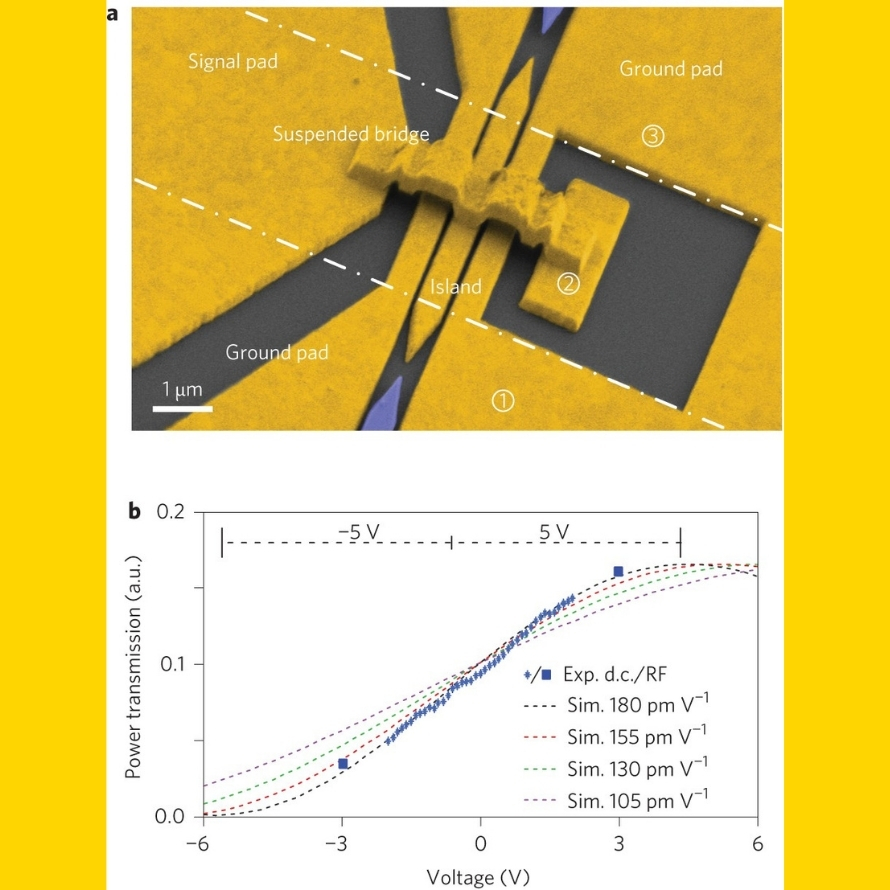
a, Colourized SEM image of the MZM components. The suspended bridge enables electrical control of the device. b, Measured (symbols) and simulated (dashed lines) optical power transfer function versus applied voltage. The simulations indicate a best fit for a material with a nonlinear coefficient of 180 pm V–1.
-
Related products

Plasmonic Organic Hybrid Modulators—Scaling Highest Speed Photonics to the Microscale
Plasmonic Organic Hybrid Modulators—Scaling Highest Speed Photonics to the Microscale
Abstract:
Complementing plasmonic slot waveguides with highly nonlinear organic materials has rendered a new generation of ultracompact active nanophotonic components that are redefining the state of the art. In this paper, we review the fundamentals of this so-called plasmonic- organic-hybrid (POH) platform. Starting from simple phase shifters to the most compact IQ modulators, we introduce key devices of high-speed data communications. For instance, all-plasmonic Mach-Zehnder modulators (MZMs) are reviewed and long-term prospects are discussed. This kind of modulator already features unique properties such as a small footprint (<; 20 μm 2 ), a large electro-optic bandwidth (> 110 GHz), a small energy consumption (~25 fJ/b), a large extinction ratio (> 25 dB) in combination with a record small voltage-length product of 40 Vμm. Finally, as an example for seamless integration we introduce novel plasmonic IQ modulators. With such modulators we show the generation of advanced modulation formats (QPSK, 16-QAM) on footprints as small as 10 μm × 75 μm. This demonstration ultimately shows how plasmonics can be used to control both phase and amplitude of an optical carrier on the microscale with reasonably low losses.
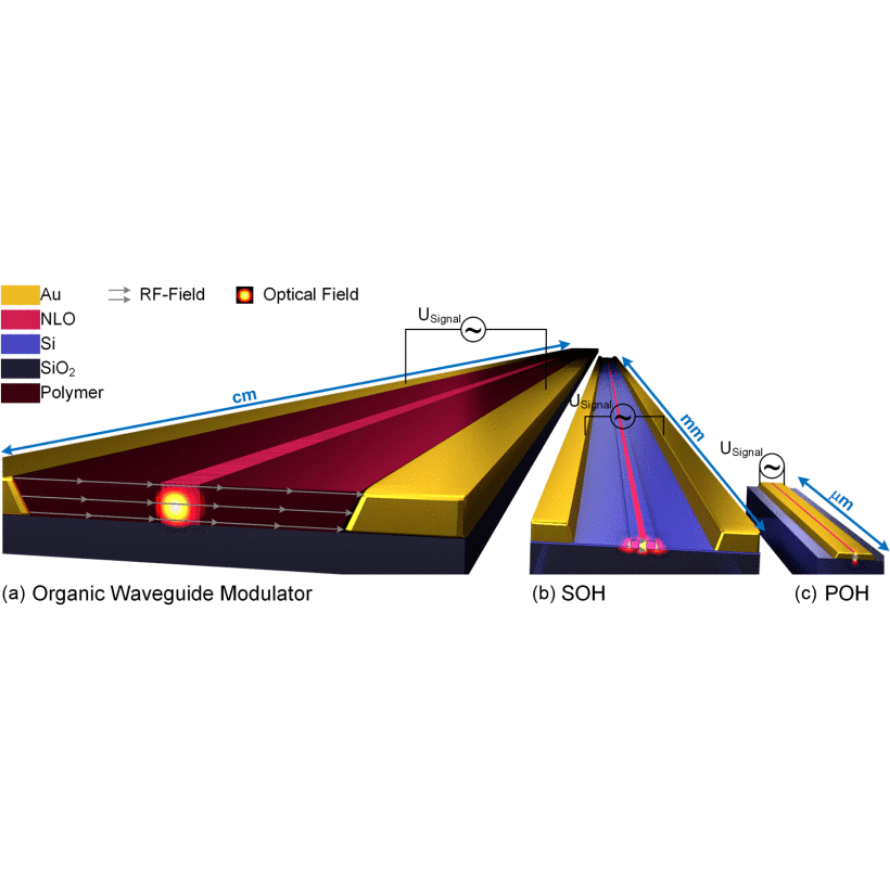
Artistic view of different organic modulator technologies. (a) Organic waveguide modulators. Light (optical mode profile) is guided within a waveguide formed by the organic NLO material; the phase is modulated by the applied drive voltage USignal and drops off over the distance of a few micrometers as indicated by the radio-frequency (RF) field (gray). Such organic modulator devices have centimeter lengths. (b) SOH modulators have submillimeter lengths. Here, the electrical field drops only over the slot filled with the organic material. However, the performance is still limited as the diffraction limit forbids complete confinement of light to the slot. (c) This can be overcome by the POH approach, which is not diffraction limited and enables modulator lengths of only several micrometers.
